In his latest TEDtalk, Sir Ken Robinson explains an evolution in education is not enough, we need a revolution. Some of my field colleagues will say evolution is the only affordable and pragmatic way. At the same time our gut feeling tells us fixing up of the existing system with (gaming) tools and (flexible) timetables will save the day but not the century.
Our kids are in trouble with us, so we better get started with moving from industrial education to organic education!
Paul van Zoggel
Stuff on Didactics, Youth, Survival
-
-
 Last week we were at our new children’s doctor practice in Vienna, Dr.med. univ. Reinhard Mitter and he reminded me of the Blue Economy. Busy as a bee organizing our ‘own’ green, blue, red economy, I didn’t look at Gunter Pauli his site for a while. Looking at it now, I realize Gunter Pauli is really up to something important for society, everything is coming together. If you run out of business idea’s, pick one of the 100 he is listing at Zeri
 -
Other than ‘standard’ western education is mostly focused on the development of ‘individual potential’. Instead of a linear path to collectively follow, though an organic, personal path. This sounds great, though most initiatives disappear after extra start-up funding stops, it’s simply too expensive. The one’s which stay standing look perfect, though miss out on a few thinking skills I believe. ‘Special Education’ get’s standard more finance as the children there need ‘special’ attention. This group grows like crazy, but that’s another story…

The new buzzword is ‘organic education’, individual learning paths, how are we going to finance it sustainably? Ofcourse computers etc will help to cover costs on guidance. But it’s not JUST an evolution on educational material. Yes, Ken Robinson his talk inspired me, it’s greatly motivational and puts the finger on the problem and the challenge, though what is the solution. In the latest Apple in school campaign you see OIPC, or One IPod Per Child supports the idea of individual paths and books success on learning motivation and achievements.
There are all kinds of success stories around the world, starts of ‘revolution’ and somehow it all needs to get together. As teachers opt-out, children are bored and parents are worried, how fast can the ‘switch’ take place? -
The primary school teacher changes his/her role in the classroom. As a necessity, to many drop out and kids are ‘diiferent’, though also as a natural progression. This short film (Dutch only) explores 5 trends and reasons why a primary school teacher will love to ‘teach’ in the near future.
ISE2020 Trailer from Trans(ce) Creatives on Vimeo.
-
Teacher, can I have MORE tasks? Would love to be that kid in school, happy to get homework and ask for more. Greedy smurfs 😉 I did not like homework, it was boring memorizing history and geography stuff.
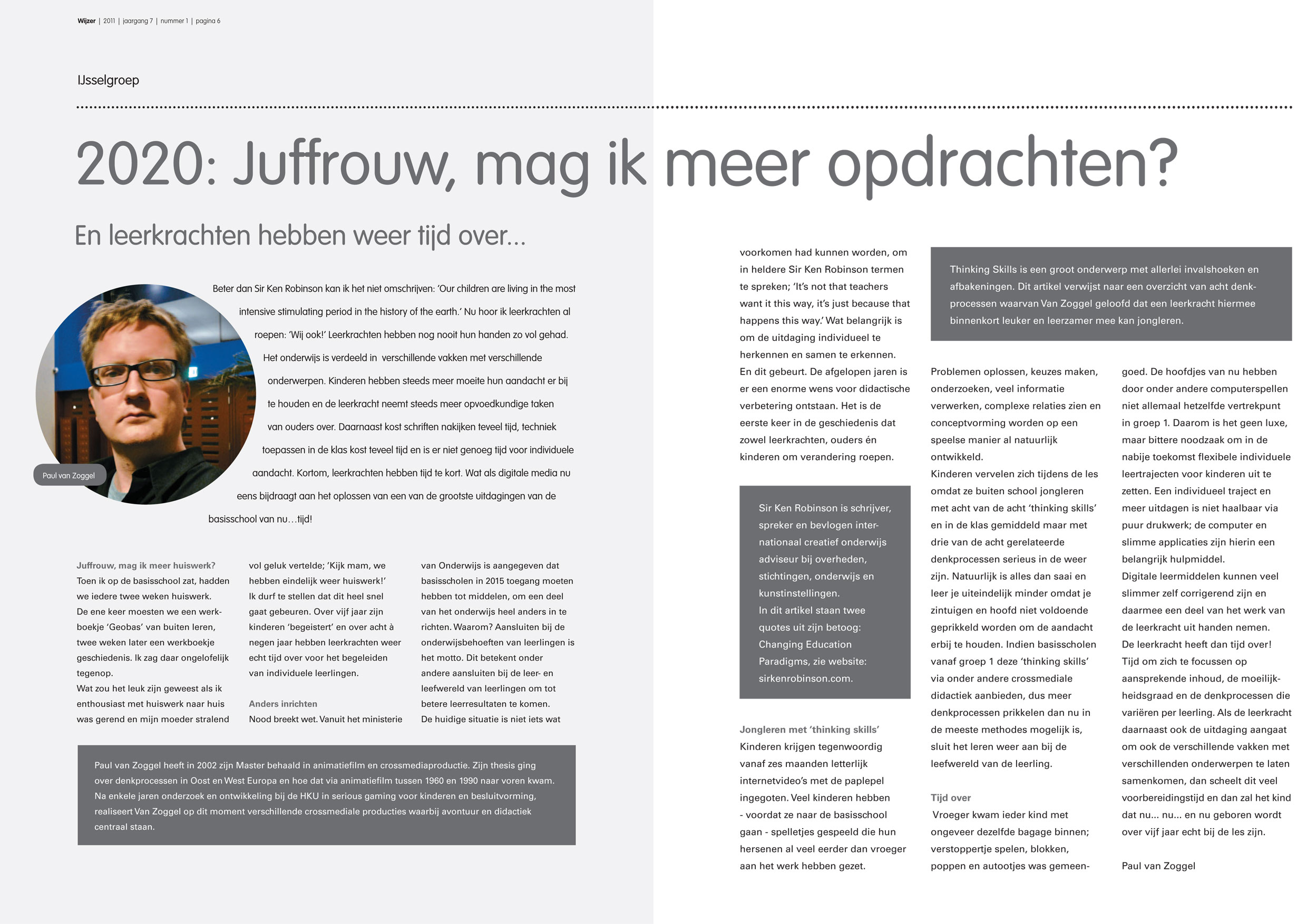
Can we imagine a primary school in the future where kids love to learn? Why are kids REALLY-REALLY bored? More bored than I was? Going nuts? Needing medication to focus?Better than Sir Ken Robinson I cannot describe it;”Our Children are Living in the most intensive stimulating Period in the History of the Earth“. We need to find an answer to this challenge. I was asked to write a small article for a pedagogical magazine going to primary school teachers and boards. It’s article for IJsselgroep, Iselinge Hogeschool in the Netherlands: “Teacher can I have more tasks? and why teachers will have precious time left again” (in Dutch page 6-7) It’s the start of my quest in understanding why children are bored in school and why change will happen.
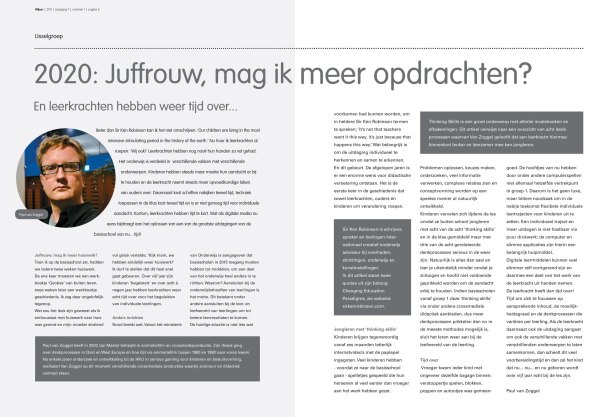
In summary; At home through play children develop 8 of 8 core brain activities. In school only 3 of 8 really get stimulated, ofcourse they are bored. Change is possible, as for the first time in history teachers, parents AND children are screaming for a shift in ‘schooling’.
Click on the link or the image to read the full article.
-
Leerkracht als nieuwe Avatar (Teacher being the new avatar), is the subtitle of the new research lab ‘crossmedia didactics’ at Iselinge Hogeschool / IJsselgroep in Doetinchem, the Netherlands, led by Joost Cohensius. The goal is to bridge academic learning wisdom with crossmedia trends from the publishing/social domain. Teachers in primary schools slowly growing into new roles as the ‘industrial’ way of learning no longer fulfills children needs and society demands. The teacher is becoming partly virtual (avatar) and partly ‘conductor’ of learning material and goals.
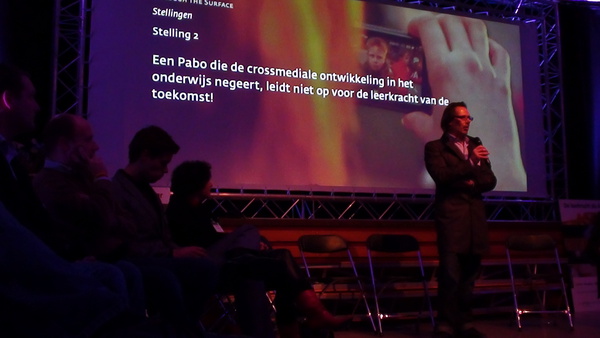
 Today was the launch of ISE2020 and the presentation of the complete 2010-2012 research and development plan. The setting was state of the art; The ISE2020 Film was shown with real 4D ambilight!
 -
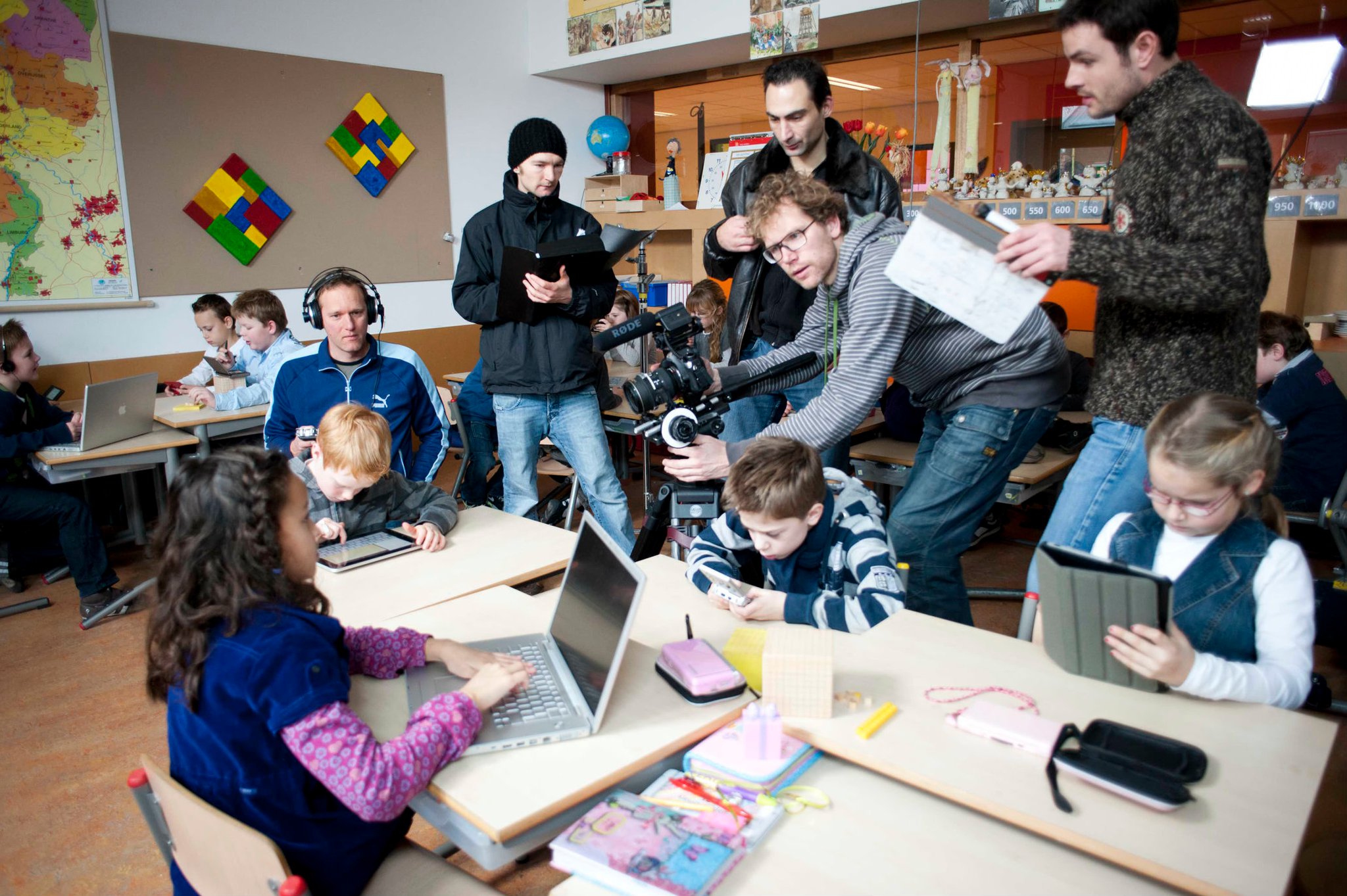
 For months we have been working on preparing the shooting days for the new Iselinge/IJsselgroep film. Initiated by IJsselgroep and Joost Cohensius, it is not the ordinary promotional film though a true ‘hollywood style’ fiction short film. 16 minutes, various locations in 3 days shooting; We took over parts of University @Iselinge, Cultural Heritage site @Drufabriek and Primary School Het Timpaan (photo). By ‘coincidence’ we will have the first ‘cinema screening’ on 02-02 as part of the launch of the new Iselinge/IJsselgroep research and development lab/professorship ‘crossmedia didactics’ chaired by Joost Cohensius.
 -
Thinking Skills became a popular name for mind skills children need to learn in primary schools. On the one hand teachers talk about them as a simple checklist to put in the mental luggage of children, on the other hand the academics among us can diversify the abilities in a way most other academics need an extra set of thinking skills to understand them.
One day I ended up between the teacher and academic world: My noble task was to think of a game engine supporting thinking skills, teachers would use and academics would accept…v a l o r i z a t i o n…
System Designers like completeness. There is nothing more annoying halfway the trajectory somebody comes in and says:”Ah, forgot about this, this also HAS to be in”. So a game architect as I try to be, I look at Bloom’s Taxonomy. WOW, did I learn all these in primary school?!. Is it complete? Sounds all logical, so could be. But what tells me? At the same time there is a nice list of 8 thinking processes, all look sensible, and I understand them immediately! So if I understand them instantly, more people would I guess. Though as I am a strong believer in yin-yang, leftbrain-rightbrain exchange and balancing, how do these 8 relate to that?
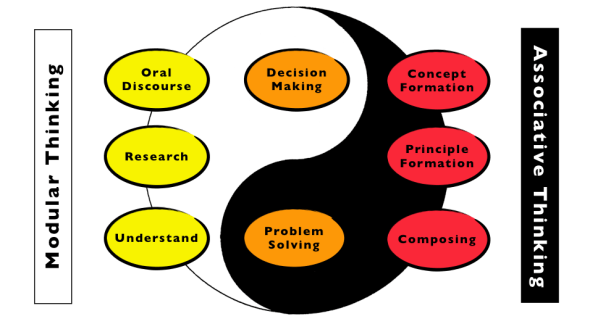 This is the result, there is a logic to it, though that’s a bit more information than suitable for a blog post I don’t want to bore you with. Drop me a line if you want to know more.
The game engine is a work in progress, also just drop me a line if interested.
-
A thought; If we want to have solved the basic learning dilemma by 2020, we have 1 year to create the primary school supporting it! As from 2012-2020 the first kids should be on it, testing it. We need to see for 8 years (age 4-12) if it works or not, than it is ‘academically’ correct. This sounds like an impossible challenge, to take a deep breath and change the education paradigm and hope it will work out in 8 years from now… Well, IT IS. We can’t take risks and damage almost a whole generation with an educational experiment.
Different than 10 years ago, teachers, parents AND children demand a revolution. Probably the first time in history. I will write an article in the IJsselgroep Magazine ‘De Wijzer’, imagining the future kid at school. (#Update Feb’11, article published: “Teacher, can I have more learning tasks? (in Dutch, page 6-7)“
-
Amazon search results on year numbers :
2010 – 176,494 (lower than 2011, probably because books got ‘old’)
2011 – 206,526 (highest, as we are in it)
2012 – 40,495 (end of the world as we know it)
2013 – 3,587 (when writing about 2012 got too crowded)
2014 – 40,117 (so, what’s that about?)
2015 – 3,255 (that’s a drop!)
2016 – 10,099 (rise…)
2017 – 351 (oops..)
2018 – 397 (ready?)
2019 – 338 (set…..)
2020- 2,328 ‘VISION BOOKS’Some just have the numbers in the titles, though a tremendous amount 2020 titles are about the brave future ahead of us. 2020 is a nice dreaming number, so let’s all together work towards that! Right? 2020 has been adopted by many company and government officials, so let’s jump on the wave and make it all happen by 2020.